Commercial ovens are among the most heavily used pieces of equipment in any professional kitchen. A busy restaurant oven may be running for twelve hours or more per day, reaching high temperatures hundreds of times each week. Under that level of use, faults are not a question of if — they are a question of when, and what kind.
Understanding the most common oven faults, and having some insight into how they are diagnosed, helps kitchen managers and chefs respond more effectively when problems arise. It also helps in communicating clearly with a service technician and understanding the work they are recommending.
This article covers the major categories of commercial oven failure — gas ignition issues, temperature problems, convection faults, combination oven specific faults, and control system errors — and explains the diagnostic process technicians use to identify the root cause of each.
Gas Ignition Failures
Gas ignition problems are among the most frequently reported faults on commercial gas ovens. They manifest in several ways: the oven will not light at all, it lights and then goes out shortly after, or it requires multiple attempts before ignition is established.
The Thermocouple and Its Role
Most gas ovens use a thermocouple as a safety device — a small probe positioned in the pilot flame or burner that generates a small electrical voltage when heated. This voltage holds open a safety valve that allows gas to flow to the main burner. If the thermocouple fails or is not heated adequately, the safety valve closes and gas is cut off, which is why the oven will not stay lit even when gas is available.
Diagnosing a thermocouple fault involves measuring the output voltage with a multimeter. A healthy thermocouple produces a specific millivolt reading; a low reading indicates a failing device, and a zero reading indicates complete failure. Thermocouple replacement is generally a straightforward repair once the fault is confirmed.
Igniter Electrode Issues
Piezoelectric igniters on gas ovens can fail through contamination, cracking, or electrode gap changes. A technician will visually inspect the electrode tip for deposits and cracking, check the electrode gap against specifications, and test the spark output. In many cases, cleaning is sufficient; in others, replacement of the electrode assembly is required.
Gas Valve Problems
Gas valves can fail mechanically or electrically. A stuck or failed main gas valve will prevent gas flow even when ignition and thermocouples are functioning correctly. Diagnosing a gas valve fault typically involves confirming gas pressure at the valve inlet, then testing whether the valve is opening in response to the correct electrical signal. Gas valve work must be carried out by Gas Safe registered engineers.
Temperature Inconsistency and Calibration Drift
Temperature accuracy is fundamental to the performance of a commercial oven. Calibration drift — where the oven's internal temperature differs from the set temperature — is a common problem that develops gradually over time. It is frequently not noticed until it affects food quality: dishes over-cooking, pastry not rising correctly, proteins cooking unevenly.
Thermostat Faults
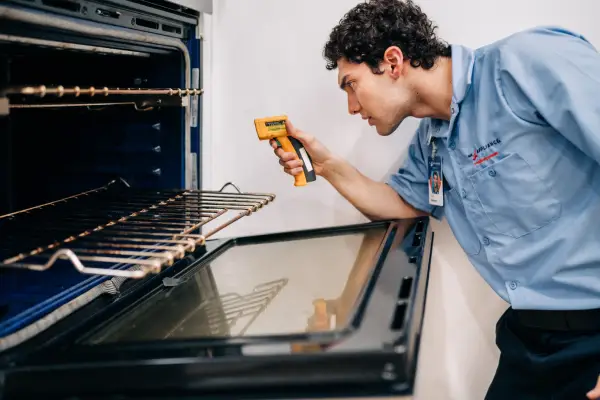
The oven thermostat senses internal temperature and controls the burner or heating element accordingly. Thermostats can drift from calibration, particularly in older equipment — meaning the oven may read 200°C on its dial but actually be running at 185°C or 215°C. A technician uses a calibrated temperature reference — typically a digital probe thermometer or thermocouple logger — to measure the actual oven temperature at multiple points and compare it against the thermostat setting. Where drift is moderate, recalibration may be possible; where the thermostat has failed outright, replacement is necessary.
Temperature Probe Failure
Combination and modern convection ovens use electronic temperature probes (NTC sensors or PT100 probes) rather than mechanical thermostats. These probes can fail through physical damage, moisture ingress, or electrical deterioration. A failed or inaccurate probe will cause the oven's control system to receive incorrect temperature data, resulting in over- or under-heating. Probes are tested by measuring their electrical resistance at known temperatures and comparing against the manufacturer's specification.
Uneven Temperature Distribution
Hot and cold spots in an oven can result from several causes: a blocked or damaged burner in a gas oven, a failed heating element section in an electric oven, or a faulty convection fan motor. Technicians use temperature logging equipment to map the oven's internal temperature at multiple points during a heating cycle, which helps identify the source of the variation precisely rather than guessing.
Convection Fan Faults
Convection ovens use an internal fan to circulate hot air, improving temperature uniformity and cooking speed. Fan faults reduce or eliminate this air circulation, which affects both cooking performance and energy efficiency.
Fan motor failure is the most common cause, and it can present gradually — starting with reduced airflow before the motor fails completely. A technician will check the motor for continuity and insulation resistance, inspect the fan blades for damage or grease build-up (which can cause imbalance and bearing wear), and test the motor capacitor if applicable. In many cases, a fan motor can be replaced without replacing the entire oven.
Combination Oven Specific Faults
Combi ovens — which combine dry heat and steam — are more complex than standard ovens and have additional failure modes related to their steam generation and water management systems.
Steam Generation Problems
Most combi ovens use either a boiler or a direct water injection system to produce steam. Boiler-based units are susceptible to limescale build-up in hard water areas, which reduces heating efficiency and can eventually cause boiler failure. Regular descaling is essential maintenance for boiler-type combis. Water injection systems rely on correct water pressure and solenoid valve operation — faults here result in insufficient or no steam production.
Error Code Diagnostics
Modern combination ovens display error codes when they detect faults in their systems. These codes are manufacturer-specific and refer to sensors, actuators, or communication faults within the control system. A technician with access to manufacturer technical documentation can interpret these codes accurately and use them as a starting point for diagnosis, significantly reducing the time needed to identify a fault.
Error Code Caution: Error codes indicate that the control system has detected a problem, but they do not always precisely identify the faulty component. The same error code can sometimes result from different underlying faults. Experienced diagnosis involves using the code as a guide, not a definitive answer.
Door Seal and Hinge Problems
Oven door seals serve a critical function: they contain heat within the oven chamber and prevent energy loss. Deteriorated seals are more common than their significance suggests — they degrade gradually through heat cycling, cleaning chemical exposure, and physical wear, and the effect on oven performance is often attributed to other causes.
A straightforward test involves holding a piece of paper at various points around the closed oven door and noting any that move in the airstream, indicating heat escape. A thorough visual inspection of the seal for cracking, deformation, and gaps should be part of any routine maintenance visit. Door hinges that are bent or worn also cause seal failure and should be checked alongside the seal itself.
Electrical Control System Faults
Modern commercial ovens incorporate increasingly sophisticated electronic control systems — programmable recipe management, touchscreen interfaces, and network connectivity in some models. While these features add functionality, they also introduce additional failure modes.
Control board failures, sensor wiring faults, and display issues all require electronic diagnostic skills. Technicians use schematic diagrams and systematic testing to trace electrical faults — checking supply voltages, testing sensor outputs, and identifying failed components. In some cases, a faulty component can be replaced on the board; in others, a replacement control board is required.
When to Call a Technician
Any gas-related fault should be investigated by a Gas Safe registered engineer without delay. Temperature inaccuracy that persists after basic checks, unusual noises, burning smells, error codes that do not clear, and any fault that recurs after staff have attempted to resolve it are all situations where a professional diagnostic visit is warranted. Attempting internal repairs without the correct qualifications and tools risks further damage to the equipment and potential safety hazards.
Providing a clear account of what symptoms have been observed, when they started, and what has changed since then is genuinely useful information for a technician at the start of a visit. The more context available, the more efficiently the fault can be traced.